A Complete Guide to World Currencies: What Every Country Uses
There are around 180 recognised currencies in the world — far fewer than the 195 countries, as many nations share currencies or use the US Dollar. Currencies reveal a great deal about a country's history, independence and economic relationships. Here is a complete guide to the world's most important currencies.
The World's Most Traded Currencies
Not all currencies are equal. The global foreign exchange market trades about $7 trillion per day, but this market is dominated by just a handful of currencies. The US Dollar is involved in about 88% of all currency trades, making it far and away the world's dominant currency. The Euro is second, followed by the Japanese Yen, British Pound, Australian Dollar and Canadian Dollar.
- •US Dollar (USD) — The world's primary reserve currency, used in 88% of all forex trades
- •Euro (EUR) — Used by 20 of 27 EU countries and several non-EU territories
- •Japanese Yen (JPY) — Third most traded currency in the world
- •British Pound (GBP) — One of the oldest currencies still in use, dating back 1,200 years
- •Swiss Franc (CHF) — Known for stability; Switzerland not in the Eurozone
- •Australian Dollar (AUD) — Also used in several Pacific island nations
- •Chinese Yuan (CNY) — Growing in importance as China's economy expands
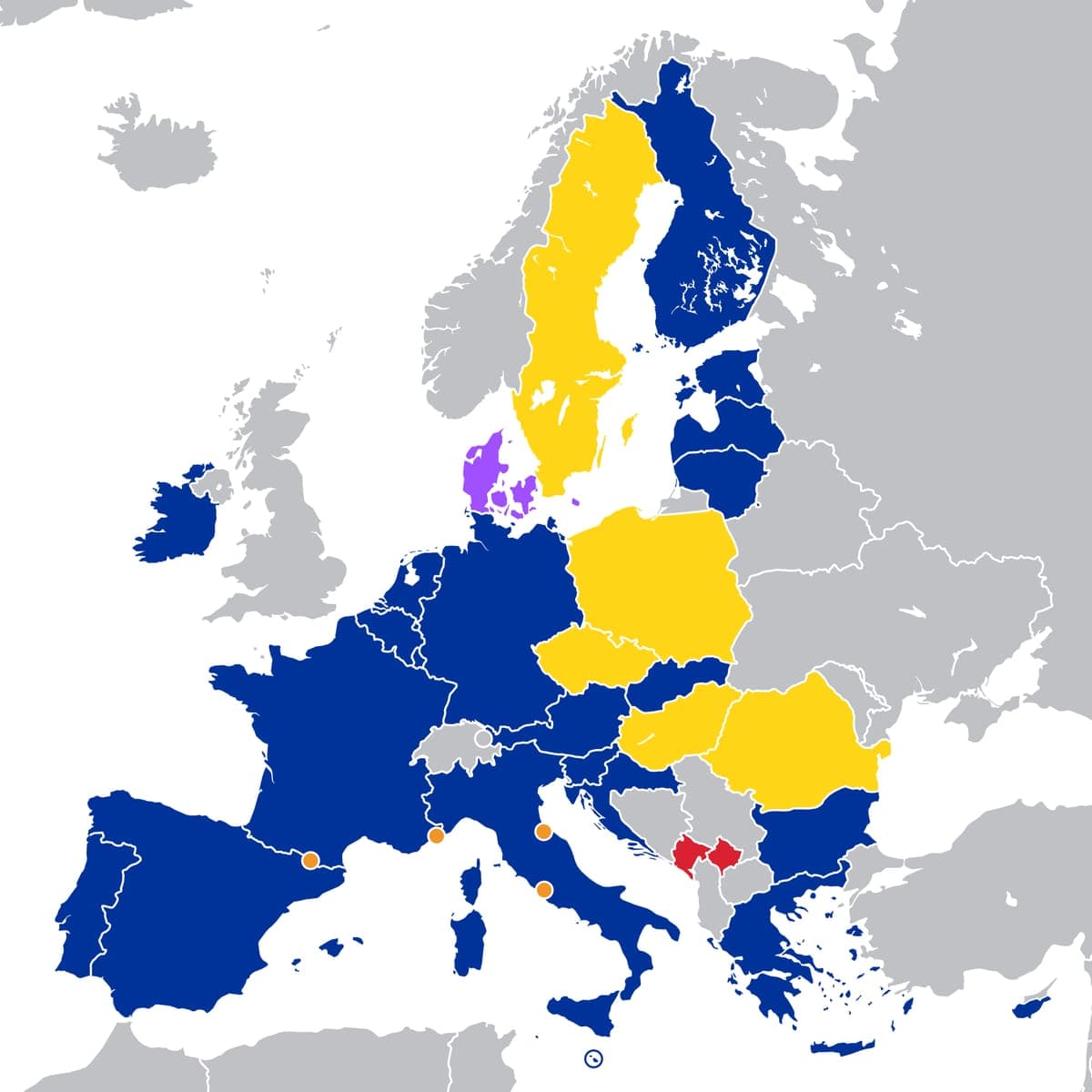
The Euro — used by 20 countries and one of the world's most important currencies
The Euro — A Shared Currency
The Euro is one of the most remarkable political and economic experiments in history. Launched in 1999 and put into physical circulation in 2002, it replaced the national currencies of member states who had been using their own money for centuries. Germany gave up the Deutsche Mark, France the Franc, Italy the Lira, Spain the Peseta. As of 2023, 20 of the 27 EU member states use the Euro. Notable holdouts include Sweden, Denmark, Poland, Hungary and the Czech Republic, all of which have chosen to keep their own currencies.
Countries That Use the US Dollar
Several countries that are not the United States officially use the US Dollar as their currency. These include Ecuador, El Salvador, Panama, Zimbabwe and East Timor. Panama has used the Dollar since 1904 due to its close relationship with the US during the construction of the Panama Canal. Ecuador abandoned its own currency, the Sucre, in 2000 during a severe financial crisis. Zimbabwe has used the Dollar since 2009 after its own currency experienced hyperinflation so severe that a 100 trillion dollar note was issued.
The World's Highest and Lowest Valued Currencies
The Kuwaiti Dinar is consistently the world's highest-valued currency — one Dinar is worth about 3.25 US Dollars. This is largely because Kuwait has substantial oil revenues and a small population, creating a strong economy. The Bahraini Dinar and Omani Rial are also very high valued for similar reasons.
At the other end of the scale, the Vietnamese Dong and the Indonesian Rupiah are among the world's lowest-valued currencies — you need tens of thousands of them to equal one US Dollar. This does not mean these are poor countries or unstable currencies — it simply reflects the nominal denomination used.
- •Highest value — Kuwaiti Dinar (1 KWD ≈ $3.25 USD)
- •Second highest — Bahraini Dinar (1 BHD ≈ $2.65 USD)
- •Third highest — Omani Rial (1 OMR ≈ $2.60 USD)
- •Lowest value (large economies) — Indonesian Rupiah (about 15,000 per $1 USD)
- •Lowest value (small economies) — Vietnamese Dong (about 24,000 per $1 USD)
African Currencies
Africa has a diverse currency landscape. Most African countries have their own currencies, but 14 West and Central African countries use the CFA Franc — a currency originally introduced by France for its African colonies. The CFA Franc remains controversial as it is still tied to France and the European Central Bank, leading critics to argue it limits the monetary independence of these nations. East Africa has been working towards a single currency — the East African Shilling — but this project has faced delays.
Currency Names and Their Origins
- •Dollar — From the German Thaler, a silver coin minted in the 16th century
- •Pound — From the Latin libra pondo meaning a pound by weight of silver
- •Rupee — From the Sanskrit rupyakam meaning wrought silver
- •Yen — From the Japanese en meaning round (shape of the coin)
- •Franc — From the Latin Francorum Rex meaning King of the Franks
- •Dinar — From the Roman gold coin denarius, spread by Islamic empires
- •Dirham — From the ancient Greek drachma
- •Rand — From Witwatersrand, the ridge where Johannesburg was built
- •Ringgit — Malay for jagged, referring to old Spanish silver coins
- •Zloty — Polish for golden
The World's Newest and Most Unusual Currency Stories
Zimbabwe's hyperinflation between 2007 and 2009 is one of the most extreme cases of currency collapse in history. At its peak, inflation reached an estimated 89.7 sextillion percent per month. The central bank issued increasingly large denomination notes, culminating in the 100 trillion dollar note. Ironically, these notes are now collectors' items worth more than their face value ever was.
The European Central Bank estimates that billions of Euro banknotes circulate outside the Eurozone — many in countries like Kosovo, Montenegro and North Macedonia that adopted the Euro informally, and others held as savings by individuals who trust the Euro more than their own national currency.
Currency knowledge is part of our World Facts quiz — test whether you know which currency belongs to which country at MyGeoQuiz!